Industry
Finance, Fintech & Investment
From risk to ROI clarity.
Your revenue number depends on who you ask. Finance calculates it one way, engineering hardcoded it another, and the board deck splits the difference with a caveat. We help finance teams, funds, and fintech companies rebuild their numbers from source — validated, auditable, and owned by the people who actually need them.
Discuss Your NeedsHow We Help
The CFO opens the revenue dashboard before the board meeting. The number looks right — close to what she expected. But she can't trace it. The calculation lives in a Jinja macro that an engineer wrote two years ago. There are three versions of that macro in production. Nobody documented why version 3.1 applies a 2.185x multiplier to one product line. The finance team can't change pricing without filing an engineering ticket. And $84M in annual revenue has never been validated against an independent model.
This is not a hypothetical. This is what we found at a cloud security platform before we rebuilt their revenue analytics from the ground up.
The pricing debt problem. Financial calculations accumulate technical debt just like software does — except the consequences are harder to detect. Hardcoded rates in SQL, undocumented adjustments, multiple formula versions with no changelog. At the cloud security platform, five years of pricing changes had been encoded directly in Jinja macros. Every rate update required a developer to edit SQL, open a pull request, and deploy. We discovered an undocumented 118% price increase that had been running in production since version 3.1, creating a $472K gap that only surfaced through reconciliation. We migrated all pricing logic into 5 structured seed tables with full rate history, then validated $84M in revenue calculations to 0.002% accuracy — a $1,634 total variance across the entire portfolio, five times better than the 0.01% target.
Silent bugs in production numbers. The validation process uncovered 15 silent production bugs. Not crashes. Not error messages. Quiet miscalculations that had been running undetected, compounding into a gap that only a parallel model build could reveal. This is the real risk of financial systems that lack independent validation: not that they'll break obviously, but that they'll drift silently.
The self-service handoff. Rebuilding the numbers is necessary but not sufficient. If finance still depends on engineering for every pricing update, the debt will accumulate again. We replaced 5 CSV seed files with 4 Sigma input tables that Finance owns directly — row edits, not code deploys. Seven dimension tables power dropdown validation to prevent the silent join failures that cause numbers to go wrong without anyone noticing. Pricing updates moved from a days-to-weeks engineering cycle to minutes.
Forecasting under uncertainty. Financial models break when assumptions break. During COVID, every demand forecast at eBay Classifieds became useless overnight — real estate and auto markets collapsed in ways no historical pattern predicted. We rebuilt forecasting models across 5+ emerging markets using scenario planning, historical "no-COVID" baseline patches, and weekly refresh cycles that gave CFOs and GMs a range of outcomes instead of a single brittle prediction. The same approach — fast iteration, transparent assumptions, multiple scenarios — applies to any finance team navigating market volatility.
M&A data readiness. When a transaction is on the table, the data you can produce determines your negotiating position. As Head of Analytics at eBay Emerging Markets, our founder built the data backbone that supported the sale of eBay Classifieds to Adevinta, and later from Adevinta to Quinto Andar. Market sizing, competitive benchmarking, portfolio performance — compiled from Semrush, SimilarWeb, INEGI, Google Trends, GA, and internal sources into analytics that powered pitch decks and buyer due diligence.
What the engagement delivers. Revenue calculations you can trace from raw source to final number. An audit trail that holds up under scrutiny. Finance-owned pricing and parameter tables that update without engineering dependency. Forecasting infrastructure that adapts to changing assumptions instead of breaking. And a foundation that makes the next audit, the next board meeting, the next due diligence cycle faster — not another fire drill.
Diagnostic questions. Can your CFO trace today's revenue number from the dashboard back to the source transaction? When was the last time someone validated your financial calculations against an independent model? If finance needs to update a pricing parameter, does it require an engineering ticket?
What You Can Expect
Who We Work With
- CFO
- Fund Manager
- COO
Related Insights
View all
The 60,000-Row Excel File That Changed Everything
After 15 years building data systems at companies like P&G and eBay, I discovered the real problem isn't lack of data — it's the gap between having data and actually using it to make decisions.

1 Ticket to Change a Price. Not Anymore.
How we moved pricing out of hardcoded macros and into the hands of Finance — no ticket, no PR, no waiting.
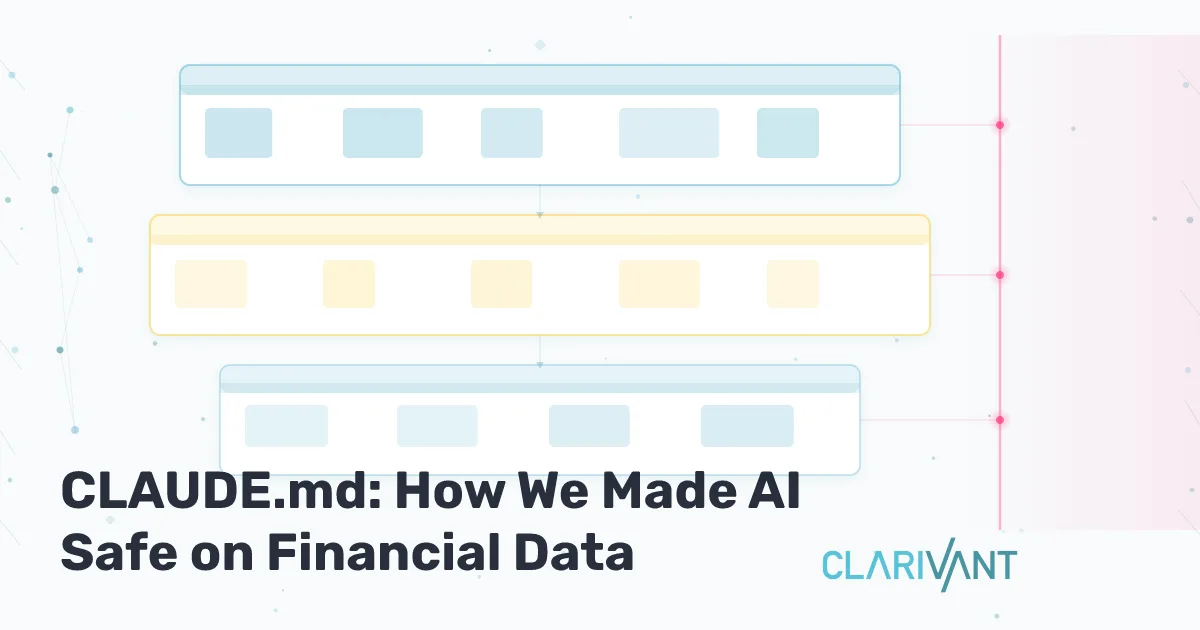
CLAUDE.md: How We Made AI Safe on Financial Data
What goes in CLAUDE.md when you're using Claude Code on a financial dbt codebase — and why hooks are a different kind of guardrail.
Frequently Asked Questions
How do you validate existing revenue calculations?
Can you give Finance direct control over pricing without engineering involvement?
How do you handle forecasting when historical patterns don't apply?
What's the typical ROI timeline for a financial analytics rebuild?
Ready to turn data into decisions?
Let's discuss how Clarivant can help you achieve measurable ROI in months.